
Blue Rider: Rebel Art
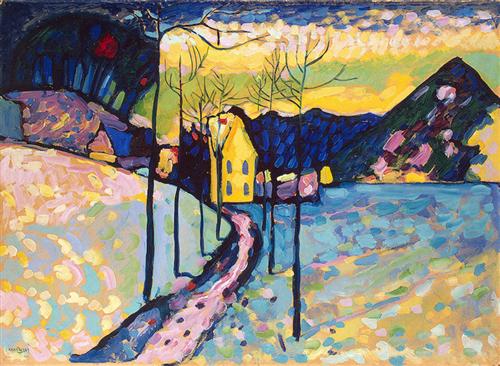
Winter Landscape I, 1909
Wassily Kandinsky
A little over 100 years ago, in 1911, a group of Russian and German artists working in Munich rebelled against the established traditions of art in Germany. The group named themselves “Blue Rider.”
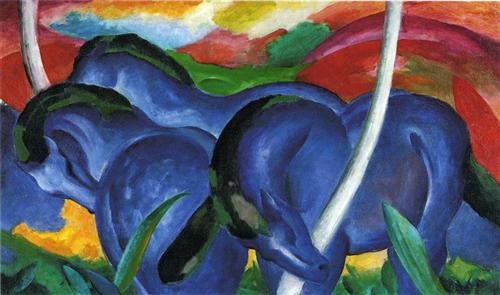
The Large Blue Horses, 1911
Franz Marc
The name was born in a conversation between two of the founders, Franz Marc and Wassily Kandinsky. Kandinsky felt the color blue was spiritual and Marc believed animals had more of this spiritual connection in the natural world than humans…hence, Blue Rider.
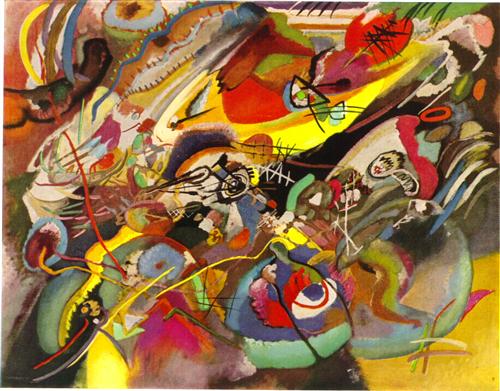
Study for Composition VII, 1913
Wassily Kandinsky
Blue Riders felt colors should be in harmony and resonate like music.
Art historian and author Cornelia Feye notes that Kandinsky was a “synaesthesist,” meaning that he could hear colors and see sound. After hearing a performance of Wagner’s opera Lohengrin in Moscow he said:
“I saw all my colors in spirit, before my eyes. Wild, almost crazy lines were sketched in front of me.”
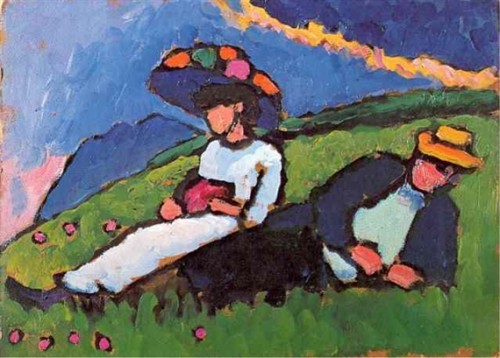
Jawlensky and Werefkin, 1908
Gabriele Münter
Gabriele Münter, also one of the founders of Blue Rider, collected children’s art. Although classically trained, she used simplified forms and colors expressing child-like innocence in her paintings.
A passionate but devastating 12-year love affair developed between Gabriele Münter and Wassily Kandinsky…another story…stay tuned for the next blog post!
Blue Rider was disbanded with the onset of WWI and the tragic war death of Franz Marc. The small avant-garde group is considered to be fundamental to the German Expressionist movement.
See Kandinsky’s greatest paintings. Click here if you are unable to view the video.
More about Cornelia Feye, art historian and author, www.CorneliaFeye.wordpress.com.
J.M.W. Turner, Brilliant Watercolorist
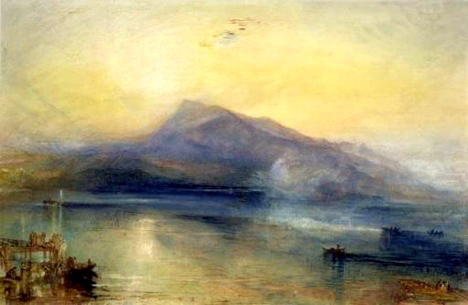
The Dark Rigi, 1842
Watercolor on paper
J.M.W. Turner
Light, light, light. Light in all its effervescence; light falling in scattered shining flecks, shimmering incandescent pigment. Light like it had never before been painted.
J.M.W. Turner (1775-1851) became the leading artist of his era. A classical painter, heavily influenced by the old masters, he introduced a new way of painting and has been hailed as a forerunner of modernist abstraction.
Turner brought watercolor painting to a sublime and respected place in the art world of the mid 1800’s. He felt watercolor described light as no other medium.
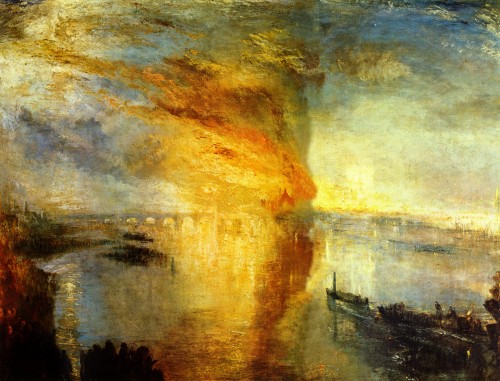
Burning of the Houses of Parliament, 1834
J.M.W. Turner
Turner was an inveterate sketcher filling hundreds of small drawing books with his impressions of nature. He went to extreme lengths to experience his world. Turner trekked remote areas, he roped himself to a ship’s mast during a ferocious storm, and in another reckless venture…he sketched the famous burning of Parliament from a rowboat in the dead of night.
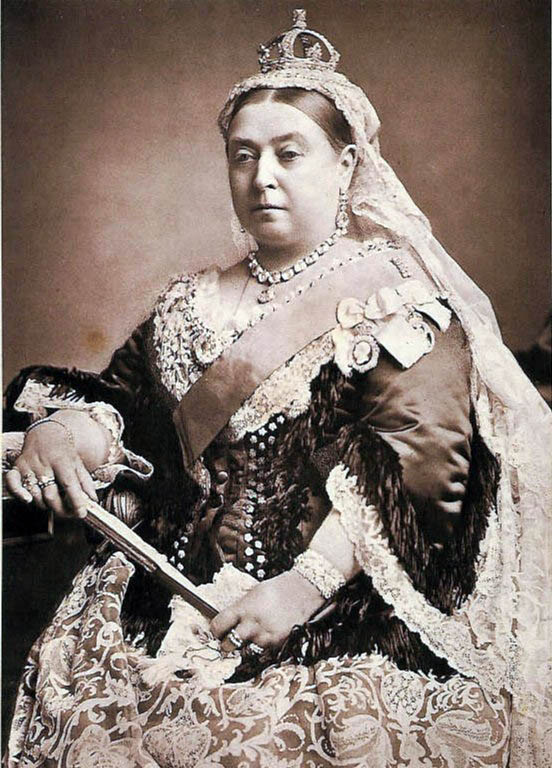
Queen Victoria, photograph
Not all were enchanted with his work. Queen Victoria touring the Royal Academy in London, pronounced Turner’s paintings, “…disgusting. A yellow mess.” Critics were suggesting he was losing his mind.
At his death in 1851, J.M.W. Turner bequeathed all his works to the British nation.
Fascinating review of Turner’s watercolors.
Click here if you are unable to view the video.
Now playing in movie theaters: Academy Award nominated, “Mr. Turner.” Not to be missed!
Click here if you are unable to view the video.
Turner, Brilliant Painter of Light
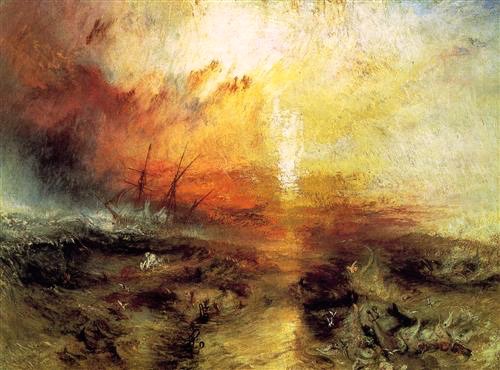
The Slave Ship, 1840
Turner
Light, light, light. Light in all its effervescence; light falling in scattered shining flecks, shimmering incandescent pigment. Light like it had never before been painted.
J.M.W. Turner (1775-1851) became the leading artist of his era. A classical painter, heavily influenced by the old masters, he introduced a new way of painting and has been hailed as a forerunner of modernist abstraction.
Burning of the Houses of Parliament, 1834
Turner
Turner was an inveterate sketcher filling hundreds of small drawing books with his impressions of nature. He went to extreme lengths to experience his world. Turner trekked remote areas, he roped himself to a ship’s mast during a ferocious storm, and in another reckless venture…he sketched the famous burning of Parliament from a rowboat in the dead of night.
Queen Victoria, photograph
Not all were enchanted with his work. Queen Victoria touring the Royal Academy in London, pronounced Turner’s paintings, “…disgusting. A yellow mess.” Critics were suggesting he was losing his mind.
At his death in 1851, J.M.W. Turner bequeathed all his works to the British nation.
Now playing in movie theaters: Academy Award nominated, “Mr. Turner.” Not to be missed!
Click here if you are unable to view the video.
Art historian’s discussion of Turner’s most famous painting, “The Slave Ship.”
Click here if you are unable to view the video.
Henri Matisse: Best Work Ever
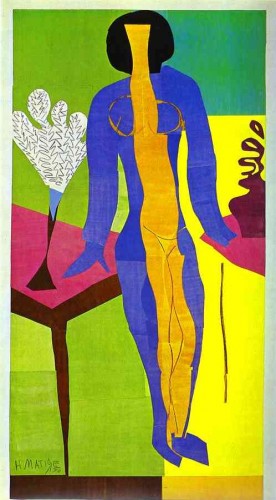
Zulma, paper cut-out, 1950
Henri Matisse
Henri Matisse (1869-1954) has risen to rock star celebrity. He is beloved throughout the world. 500,000 people packed the Tate Museum in London last summer to see his show. The Tate turned the final weekend of the run into a kind of all-night sleepover to accommodate the crowds.
Matisse said this was the best work of his long career.
In the years around 1940, Matisse must have felt he was living a nightmare. In 1939, he and his wife of more than four decades legally parted ways, at her instigation. Two years later, he was found to have abdominal cancer and underwent a grueling operation. During World War II, he fled Paris, only to have the danger of war follow him.
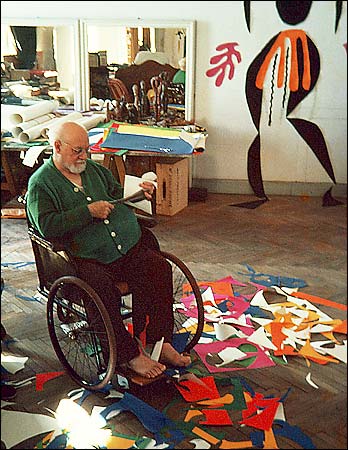
Henri Matisse working in his studio, 1952
At 71, bed- and wheelchair-bound, Matisse couldn’t paint, couldn’t sculpt. But he could use scissors.
Assistants painted large pieces of paper in colors chosen by Matisse. Then the invalid artist cut them into wild and surprising shapes. At his direction, the assistants pinned them on the wall of his hotel suite.
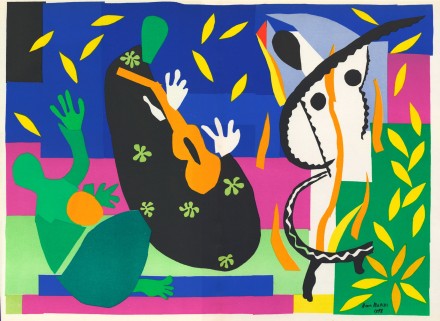
Sorrow of the King, paper cut-out, 1952
Henri Matisse
The result: works of brilliant and dimensional complexity, works that were not quite painting, not quite sculpture, and — this was the really radical part — not necessarily permanent.
Nevertheless, some of the most joyous and creative art ever produced!
Take a look at Matisse’s Cut-Outs at the Tate Modern in London. Click here if you are unable to view the video.
Henri Matisse: The Cut-Outs
The Museum of Modern Art
October 12, 2014 – February 8, 2015
3 Iconic Surrealist Paintings
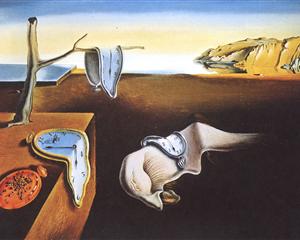
The Persistence of Memory, 1931
Salvador Dalí
The Persistence of Memory is undoubtedly the most famous Surrealist painting in history. The dripping clocks reflect the inner workings of Dalí’s subconscious and convey a simple message: time as we know it is meaningless.
What really is Surrealist art? It’s about symbols, dreams, the unconscious, perceiving things differently.
All of us have practiced the art of Surrealism when gazing at stucco on a wall, or clouds in the sky, and seeing different shapes and visages hidden therein.
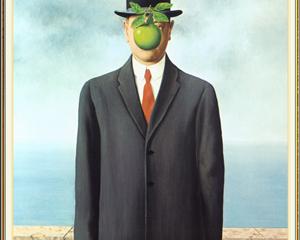
The Son of Man, 1964
René Magritte
Behind the apple in Magritte’s surreal self-portrait, we have only a brief glimpse of the eye in the corner of the face. We want to see that face.
Magritte stated that “Everything we see hides another thing. We always want to see what is hidden by what we see.”
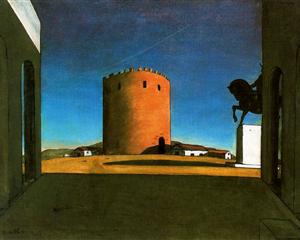
The Red Tower, 1913
Giorgio de Chirico
De Chirico’s use of color and composition reflect brooding moods and surreal landscapes.
Surrealist art. Complicated? Yes and no.
When next you are gazing at a painting and the words…fantastic, absurd, grotesque, hidden, erotic, bizarre, dreamlike…pop into your head, it is probably a piece of Surrealist art.
This video of Surrealist art and Bob Hope will make you laugh out loud! Click here if you are unable to view the video.