
The Artist We Love To Hate
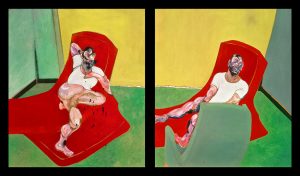
Double Portrait of Lucian Freud and Frank Auerbach, 1964
Francis Bacon
Moderna Museet, Stockholm
Was Francis Bacon really the greatest painter of the 20th century, or just a fascinating crazy mess?
Margaret Thatcher described him as “that man who paints those dreadful pictures”…..Yet, the Tate Museum in London sold out two Francis Bacon retrospective shows.
You may love or hate his work but Francis Bacon was famously known for his magnificent paintings of bold and emotionally charged raw energy.
Bacon paints as if he were an old master from 400 years ago. His paintings drip with opulent color and a velvet magnificence. The pain and brutality that punches through them heightens their strange beauty.
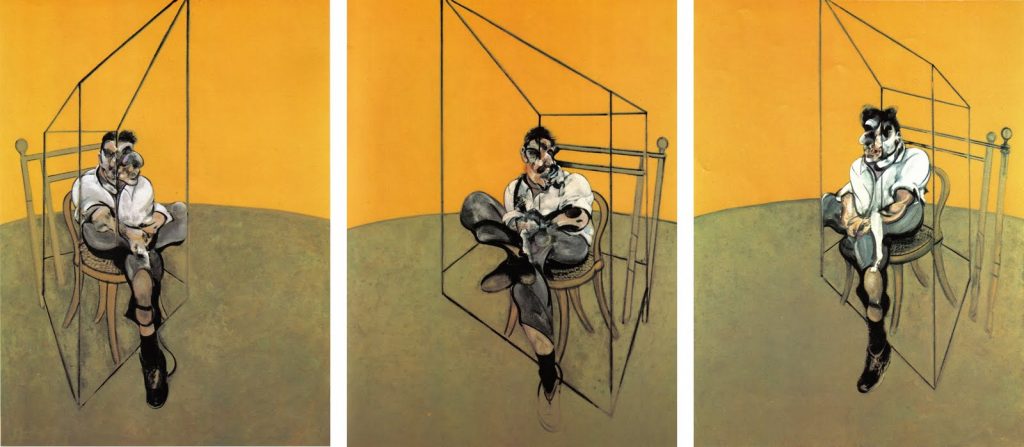
Three Studies of Lucian Freud Triptych, 1969
Francis Bacon
Private Collection
Artist Francis Bacon was born in Ireland and had a dreadful childhood at the hands of a cruel father. He lived through the grisly carnage of WWI and WWII and seems to have been driven mad by the temptations and horrors of the 20th century.
No wonder his brush creates ghastly wounds and knotted masses of flesh. No wonder he paints distorted human figures, grappling couples, screaming popes, and hysterical businessmen in suits. They leer at us from the canvas, seeming to say, “Look what humankind has done to itself.”
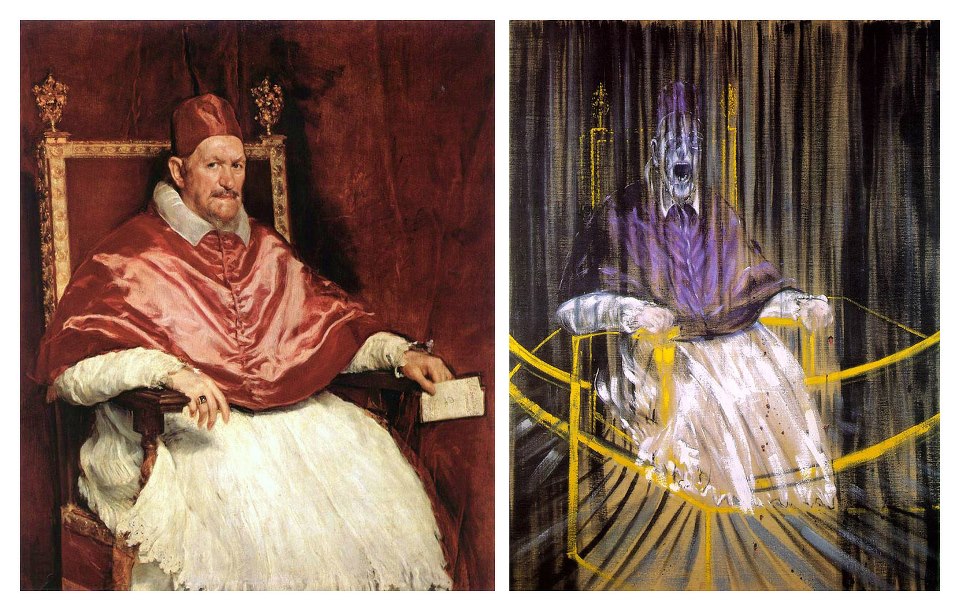
Left: Portrait of Pope Innocent X, 1650
Diego Velázquez, Galleria Doria Pamphilj, Rome
Right: Study after Velázquez’s Portrait of Pope Innocent X, 1953
Francis Bacon, Des Moines Art Center, Iowa
In 1650 AD, Pope Innocent X was arguably the most powerful man in the world, “God’s representative on Earth.” He was also a suspicious, bitter, lewd and corrupt ruler of the church.
Esteemed Spanish artist Diego Velázquez painted a beautiful portrait…but subtly hinted at Pope Innocent’s corrupt character and deep-seated deceit.
Nothing subtle about Bacon’s interpretation of Innocent. Innocent X is a screaming victim, ludicrously drag-attired, trapped in evil, and manacled to an “electric chair.” As Hugh Davies, an authority on Bacon, writes, Francis Bacon gave us a “candid camera glimpse” of the pope.
This painting is the pride and joy of the Des Moines Art Center in Iowa and is valued at more than $50,000,000.
Visit Francis Bacon’s studio, unbelievable!
Click here if you are unable to view the video.
Wondrous Event, Wondrous Art
1437 A.D.
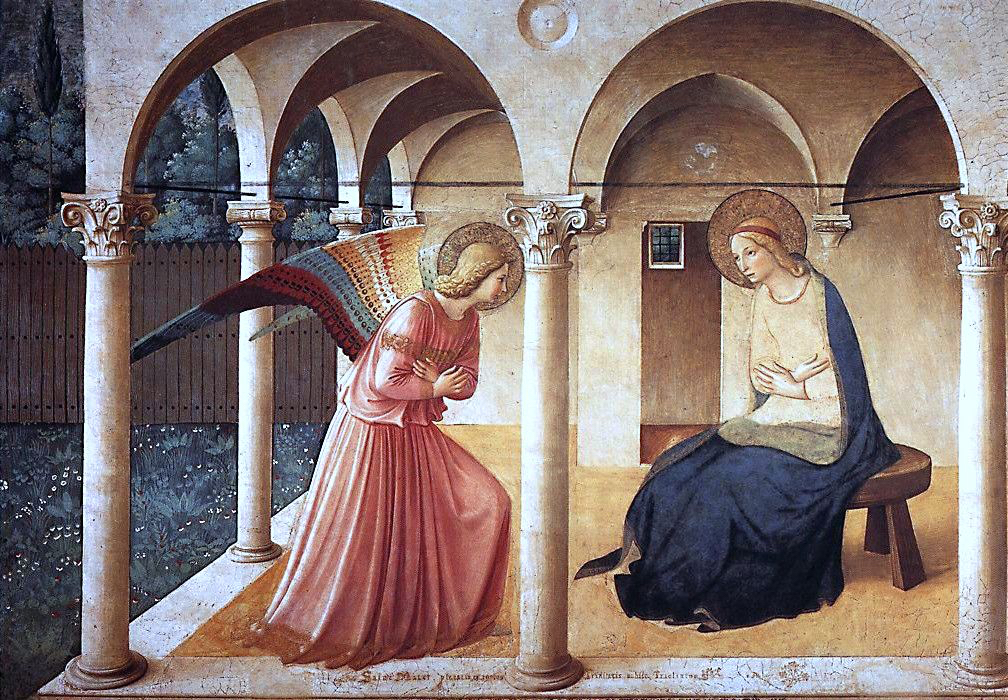
The Annunciation, 1437-1446
Fra Angelico
Convent of San Marco, Florence, Italy
The Annunciation (the announcement) is that key moment in Christian history when the angel Gabriel appears to Mary and announces that she will give birth to a son by miraculous means.
Fra Angelico, monk and artist of the 15th century, frescoed (meaning painted on wet plaster) The Annunciation, one of the most revered masterpieces of all time. Artists down the centuries have been mightily influenced by this classic work.
_______________
600 years later, 2017
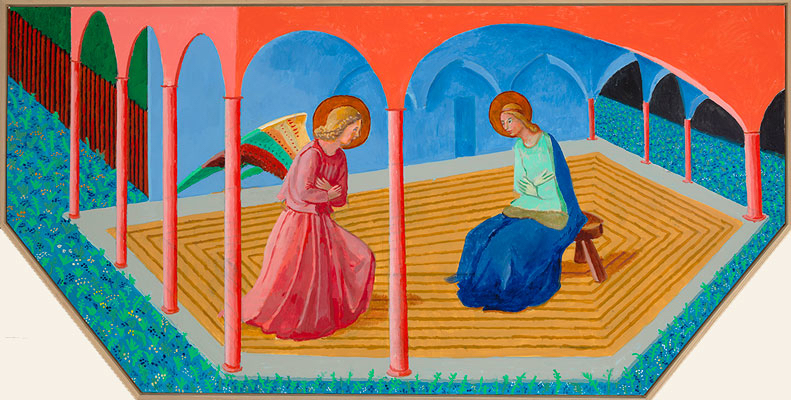
Annunciation 2, after Fra Angelico, 2017
David Hockney
David Hockney, the great 80-year-old British artist, reports that during his first year in art school he came upon Fra Angelico’s painting of The Annunciation. He was stunned by its beauty and symmetry. Sixty years later, he is still painting his interpretation of this masterpiece.
_______________
1907-1914 Cubism and Picasso astonishes art world
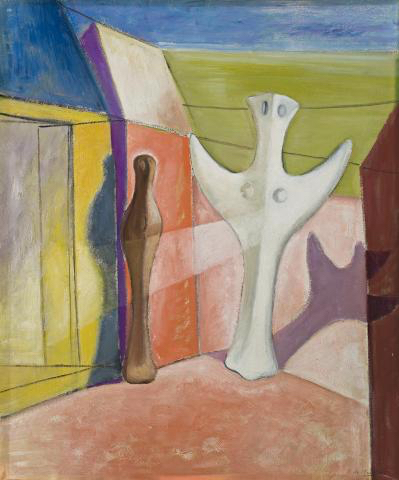
Annunciation, 1934
Roy de Maistre
Private collection, Switzerland
Cubism (objects and figures radically fragmented) heavily influenced Australian artist Roy de Maistre in his painting Annunciation.
_______________
1961-2030 Pop art transcends to fine art
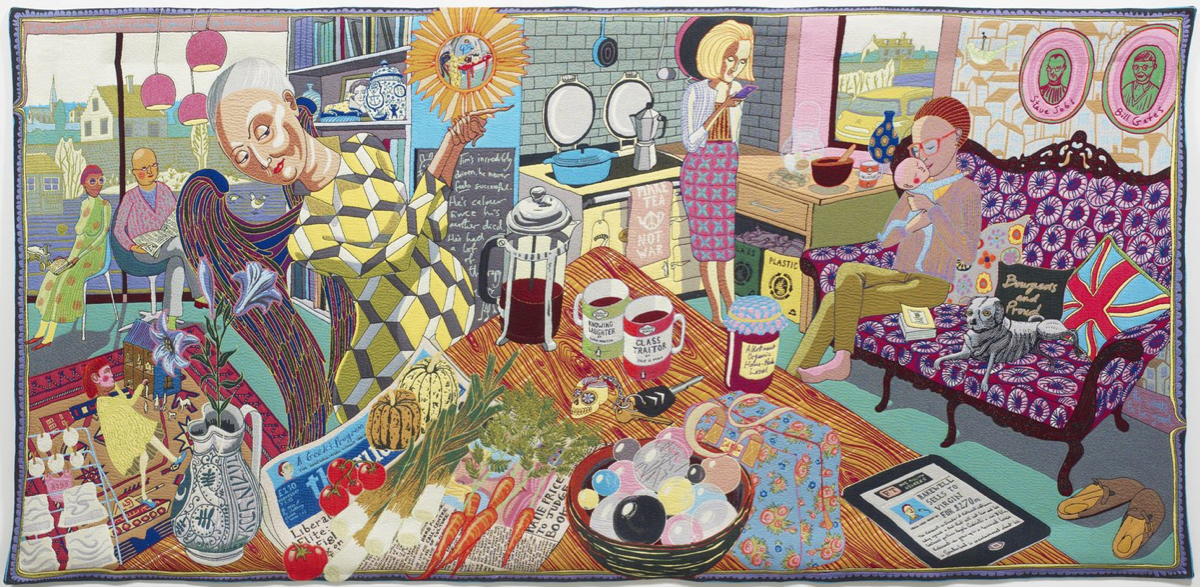
The Annunciation of the Virgin Deal, 2012
Grayson Perry
Woven tapestry in wool, silk, cotton, acrylic and polyester, Currell Collection
Grayson Perry, 60, tackles subjects that are universally human: religion, identity, gender, social status, and sexuality. He tries to deal with them with humor yet with a sense of the sacred.
The Annunciation is filled with symbols! Watch this…
Click here if you are unable to view the video.
3 Cutting-Edge Artists!

School of Beauty, School of Culture, 2012
Kerry James Marshall
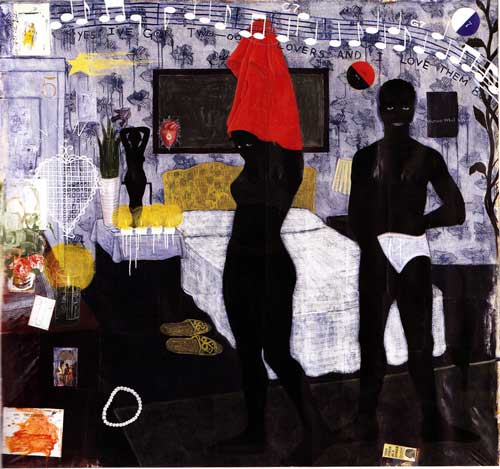
Could This Be Love, 1992
Kerry James Marshall
Kerry James Marshall
For his large-scale, exuberant paintings, 61-year-old African American artist Kerry James Marshall paints only black people.
The paintings are emotional, bursting with everyday life in riotous colors and love. Even the most staid museum visitors have been seen to kiss in front of them!
Not all his works are of happiness, though — there are funerals, killers, lost boys, anger and grief — but always depicted in bright, bold colors and powerful shapes…and always filled with vibrant spirit!
__________________

Gone: An Historical Romance of a Civil War…, 1994
Kara Walker
Kara Walker
Black contemporary artist Kara Walker shatters any romantic notion of the South, Civil War or slavery. Walker cuts out huge life-size silhouettes in black paper…nightmarish images of slavery in the Antebellum South.
__________________
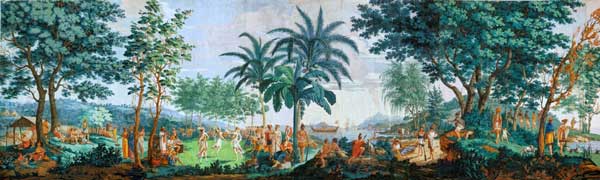
in Pursuit of Venus [infected], 2015
Still of panoramic video by Lisa Reihana
Lisa Reihana
Art and history make an explosive and exciting combination! Lisa Reihana, a Māori artist in Auckland, New Zealand, has produced a panoramic video that is irresistible in its storytelling of the encounters between the Polynesians and British Captain James Cook in 1770.
A major installation, sculpture, and video artwork is being featured at the 2017 Venice Biennale, the world’s largest art fair, depicting the profoundly beautiful and cultured Polynesians.
Watch this 1-minute video of Reihana’s work! Look for Captain Cook!
Click here if you are unable to view the video.
Research assistance by Alex Cordier, writer based in Auckland, New Zealand working in a variety of sales roles within the tourism and hospitality sectors. Alex is a passionate writer, with a particular focus on travel, lifestyle, and contemporary art.
The REAL Vincent van Gogh
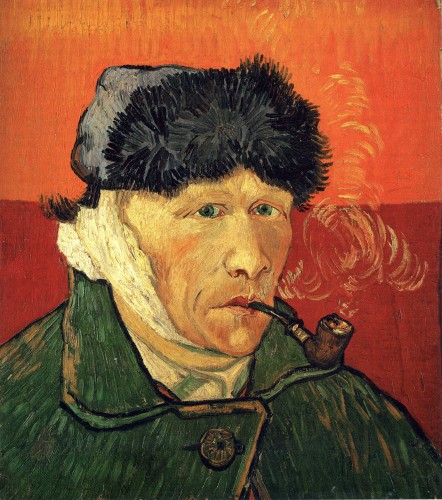
Self Portrait with Bandaged Ear, 1989
Vincent van Gogh, (1853-1890)
Myth: Van Gogh was a manic, possibly slightly deranged man who just spontaneously threw paint at the canvas.
Truth: He was a very experienced artist (he made 900 paintings in ten years) and doggedly honed his skills. He created very deliberate compositions.
__________
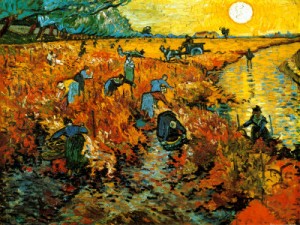
Red Vineyard at Arles, 1888
Vincent van Gogh
Myth: Van Gogh never sold a painting in his lifetime.
Truth: Van Gogh sold ONE painting during his lifetime, Red Vineyard at Arles, to a Russian collector, Sergei Shchukin. This painting now resides at the Pushkin Museum in Moscow.
__________
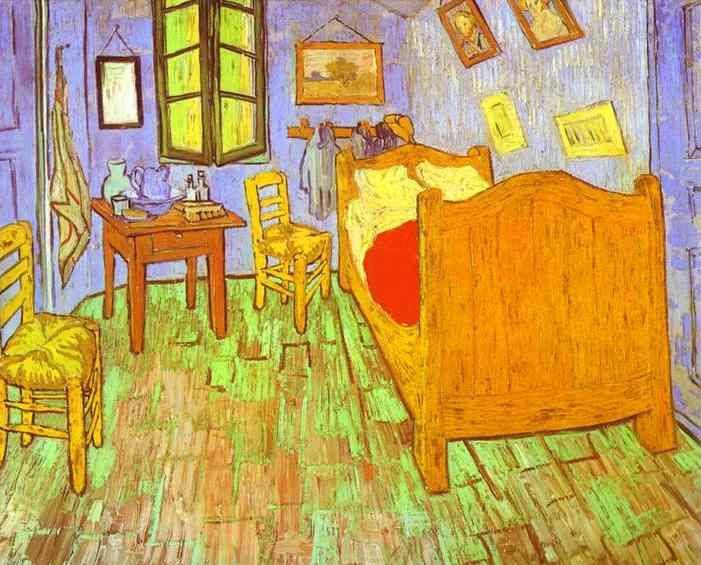
Vincent’s Bedroom in Arles, 1888
Digital version shows what may be the original violet walls.
Myth: In Van Gogh’s beloved painting of his bedroom in Arles, France, the walls were painted blue.
Truth: New high-tech research shatters Van Gogh myth! Van Gogh originally painted the walls of his bedroom a pale lilac, not blue! The reason…purple (lilac) is the complementary color of yellow. He experimented with new pigments. These new pigments, particularly the color red, proved to be unstable and the red pigment disappeared after a short time changing to blue.
__________
Don’t miss this video! Watch as Vincent van Gogh’s masterpieces come alive!
Click here if you are unable to view the video.
Great Art in 90 Seconds
Click here if you are unable to view the video.
Image: Joy of Life, Henri Matisse
Film by Kirby Kendrick
Animation by Simon Christopher, Light-Matter Media