
Would YOU buy this painting?
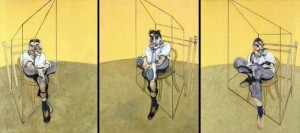
Three Studies of Lucien Freud, 1969
Francis Bacon
Someone did! A member of the royal family of Qatar, Sheikha Mayassa bint Hamad al-Thani, dubbed the most powerful woman in art, reportedly bought Three Studies of Lucian Freud.
The painting sold for $142 million dollars.
Artist Francis Bacon was born in Ireland but lived his life in England. He had a dreadful childhood at the hands of a cruel father. He lived through the grisly carnage of WWI and WWII and seems to have been driven mad by the temptations and horrors of the 20th century.
No wonder his brush creates horrific wounds and knotted masses of flesh. No wonder he paints distorted human figures, grappling couples, screaming popes, and hysterical businessmen in suits. They leer at us from the canvas, seeming to say, “Look what human kind has done to itself.”
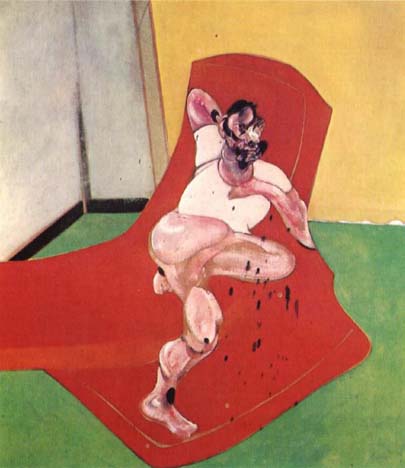
Last Tango in Paris, 1964
Francis Bacon
But hold on…Bacon paints as if he were an old master from 400 years ago. His paintings drip with opulent color and a velvet magnificence. The pain and brutality that punches through them heightens their strange beauty.
The question remains: Is that strange beauty enough for you to buy this painting?
Visit Francis Bacon’s studio, unbelievable! Click here to view the video.
California Art…Seeing is Believing
Art San Diego Contemporary Art Fair 2013
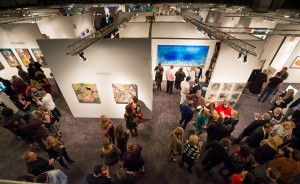
Art San Diego Contemporay Art Fair 2013
Take a quick tour of the exciting San Diego Contemporary Art Fair!
Click here if unable to view the video.
World’s Greatest Portrait Painter
The greatest portrait painter in the world?
Rembrandt Van Rijn, 1606-1669
Acclaimed master of the self-portrait, forty of which survive today.
Rembrandt’s paintings will forever change the way we experience an artist’s self-portrait. Rembrandt revealed much more than his likeness in the paintings. He painted his turbulent life for all to see. The masterly portraits painfully expose the young man’s passion and recklessness, the middle-aged man’s haughtiness and sense of self-importance and the old man’s disillusionment.
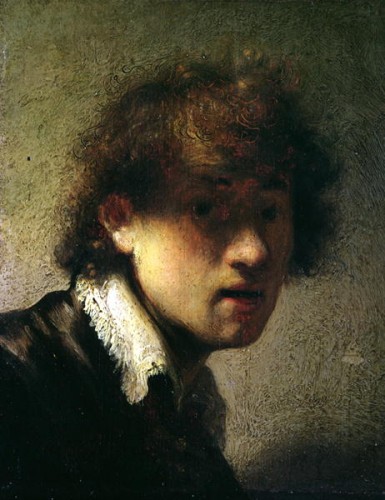
Self-Portrait at an Early Age, 1629
Rembrandt
YOUTH and ZEAL
Rembrandt, son of a miller of very modest means, arrives in Amsterdam full of ambition and hope.
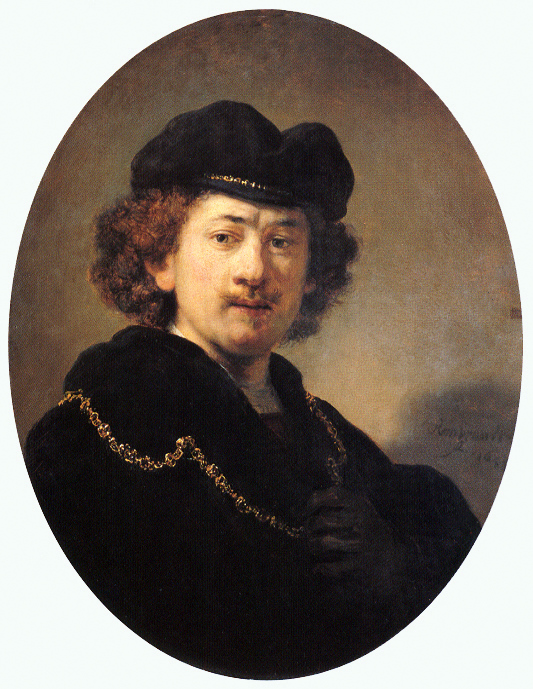
Self-portrait with Hat and Gold Chain, 1633
Rembrandt
RICHES and FAME
“The most famous artist in Amsterdam.” He marries Saskia, a woman of good family, who bears 4 children. Rembrandt lives extravagantly, beyond his means.
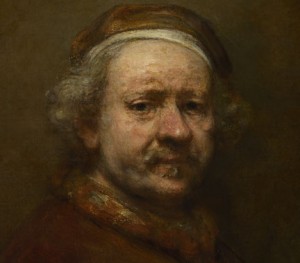
Self-portrait at Age 63, 1669
Rembrandt
DISILLUSIONMENT and DIGNITY
Personal tragedy and financial woes strike. Three of Saskia and Rembrandt’s children die and Saskia soon follows. Rembrandt is involved in court battle with his surviving child’s nurse (and his mistress), where he is sued for breach of promise. Rembrandt’s grandiose lifestyle results in a forced sale of his house and most of his possessions.
1669: Rembrandt dies at age 63 and is buried in an unmarked grave in Amsterdam.
2013: A newly discovered Rembrandt self-portrait is valued at $30 million.
Question to ponder: What would your self-portrait reveal?
Watch this video for a breathtaking trip through Rembrandt’s life!
Click here if unable to view the video.
The Earliest Art Form…Dance!
Dance has long been considered the earliest art form, but it has been elusive to capture and difficult to document. Hence, scant records of dance movements exist.
Fortunately, artists throughout time have depicted dancers on cave walls, pottery, tapestries, marble, parchment, canvas, and most recently on computer screens.
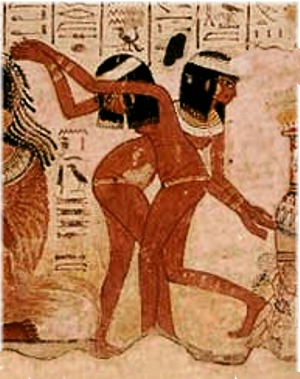
Egyptian tomb mural, 3200 BC

Claudia and Clive (digital art), 1985 AD
Judith Gray
Some of the most intimately revealing paintings of dancers are those that present couples in each other’s arms.
Doris Humphrey, a pioneer of twentieth century modern dance, believed that “the lines of both dancers must be simplified and not appear contrived or complex so as to complement each other and not distract the viewer.”
Humphrey ardently felt that the dancer’s art had something to say which could not be expressed in words or in any other way than by dancing.
Could this be true? Haven’t the visual artists also captured this intimacy and simplicity in their paintings? What do you think?
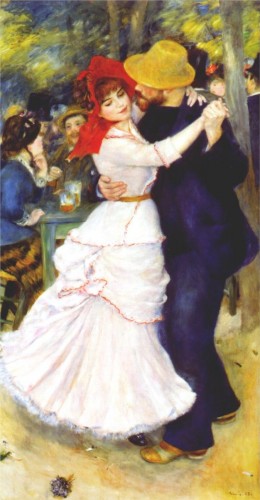
Dance at Bougival, 1883
Pierre-Auguste Renoir
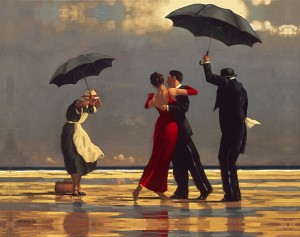
The Singing Butler, 1992
Jack Vettriano
Mikhail Baryshnikov and Gregory Hines dance their hearts out!
Click here if unable to view the video.
Guest Contributor: Judith A. Gray, Ph.D. National Dance Scholar award recipient and author of 3 dance books
Virginia Woolf: Who’s Afraid of Art?
Virginia Woolf: “One should be a painter. As a writer, I feel the beauty, which is almost entirely colour, very subtle, very changeable, running over my pen, as if you poured a large jug of champagne over a hairpin.”
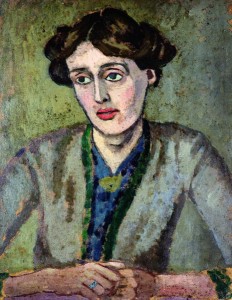
Virginia Woolf, 1912
Roger Fry
Woolf is known for her modernist novels, most notably Mrs. Dalloway and To the Lighthouse. In all of her work, she employs painterly as well as literary techniques in her portraits and metaphors. The character of Lily Briscoe in To the Lighthouse is a painter whose creative efforts are at the core of the novel.
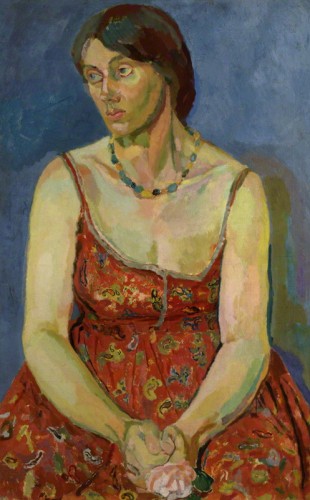
Vanessa Bell (Virginia Woolf's sister) c. 1918
Duncan Grant
Woolf had an avid appreciation of visual art and was steeped in it. Her milieu was the famous, or infamous, Bloomsbury Circle of early twentieth century London. Among the key figures of Bloomsbury, along with other writers and a token economist (John Maynard Keynes) were three notable English post-impressionist painters: Woolf’s sister Vanessa Bell, her partner Duncan Grant, and their mentor Roger Fry. The group had frequent philosophical and critical discussions about each others’ work and about the arts.
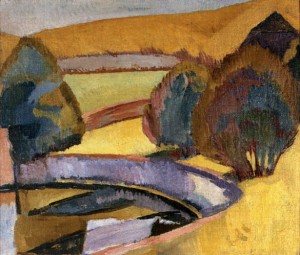
The Pond at Charleston, c. 1919
Vanessa Bell
Visit Virginia Woolf’s house! Click here if you are unable to view the video.
_______________
Alice Lowe writes about Virginia Woolf at:
www.bloggingwoolf.wordpress.com and www.aliceloweblogs.wordpress.com